
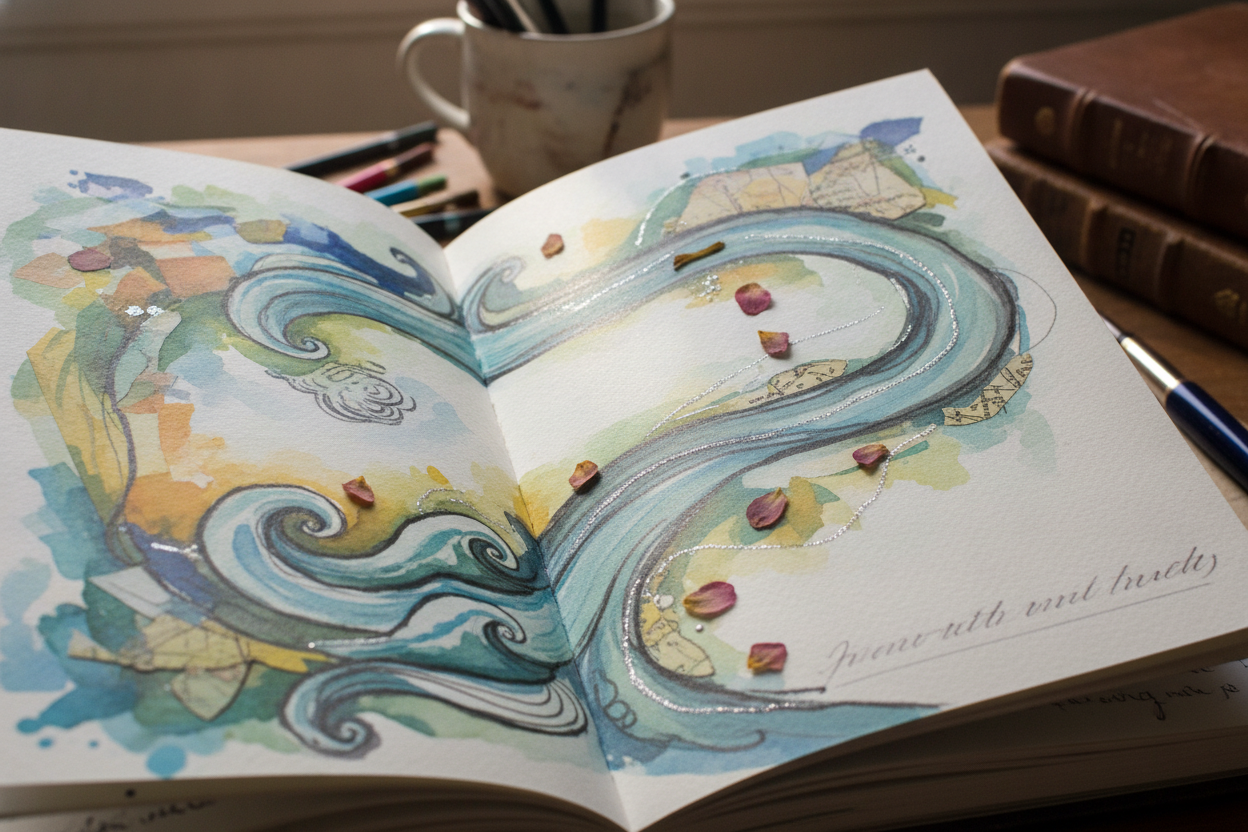
Creative writing and journaling overlap more than people often realize. Both ask you to observe closely, choose words with care, and trust that small details can carry larger meaning. If your personal writing has started to feel repetitive, adding a more creative approach can make the page feel alive again.
One way to create flow is to pay attention to rhythm. Short sentences can sharpen a feeling, while longer ones can mimic the way a thought unfolds in real time. You do not need to force literary language into every entry. Instead, focus on writing in a way that matches the energy of the moment. That natural variation keeps your pages from sounding flat.
Another useful technique is image-based writing. Instead of saying you felt overwhelmed, you might describe the room, the weather, or the physical sensation that matched the feeling. These details often make a reflection more vivid and easier to return to later. They also help transform ordinary moments into memorable entries.
Creative pages do not need to be polished to be meaningful. In fact, some of the strongest journal writing happens when you allow the voice to stay loose and personal. The goal is not to craft a perfect piece of prose. It is to let the writing move in a way that feels honest, expressive, and distinct. When that happens, your journal becomes more than a record. It becomes a living space for thought, emotion, and imagination.
Leave a Reply